Give each marketing job a name
Ryan divides the work into brand messaging, sales activation, and presence. Brand messaging is what the company wants a person to remember before a service need exists. Activation is a concrete invitation to try, schedule, or buy. Presence is the set of places where a buyer can find the company when demand is already active. This language prevents a search listing, a coupon, and a long-form story from being evaluated as if they were interchangeable ads.
Put the distinction into the campaign brief. Give every proposed asset one primary job, a named audience, a next action, and an evidence source. A search page can capture an urgent request. A maintenance offer can create a low-friction first experience. A recurring story can establish what the company stands for. They may support one another, but assigning three primary jobs to one small ad usually produces a message that does none of them clearly.
“Do you want to get found in their moment of need for the first time, or do you want to get found before their moment of need and be chosen at their moment of need?”
Ryan Chute, episode timestamp 06:13
Start with the problem the buyer recognizes
The episode contrasts customer-centered language with introductions built from awards, years in business, or the founder's biography. Those facts can become proof later, but they are not yet an answer to a cold house, a failed water heater, or uncertainty about whom to invite inside. The opening message should name the situation, show that the company understands its consequence, and state the kind of help available without inflating urgency or fear.
A practical test is to read the first two sentences without the logo. Can the intended homeowner recognize the problem and understand why the rest is worth hearing? If not, replace self-description with the buyer's question. Then use licenses, training, process, local history, and verifiable reviews as support. This keeps empathy from becoming empty sentiment and competence from becoming a list of credentials with no connection to the decision in front of the customer.
Build memory before the service need
Ryan argues that logos, colors, wraps, and websites represent a brand but do not substitute for its message. The strategic question is what useful association should remain when the advertisement is over. For a home-service company, that association might be careful diagnosis, plain explanations, respect for the home, or a defined specialty. It must be specific enough to guide creative work and true enough that dispatchers, technicians, and invoices can reinforce it.
Write one memory objective rather than a collection of slogans: when a homeowner encounters this problem, they should connect our name with this credible form of help. Repetition then has a purpose. Each story can approach the association from a different example while preserving the same core. If the field experience contradicts it, fix the operation before buying more reach. Advertising can make a promise familiar; only delivery makes that familiarity trustworthy.
Carry relationship context into the booked call
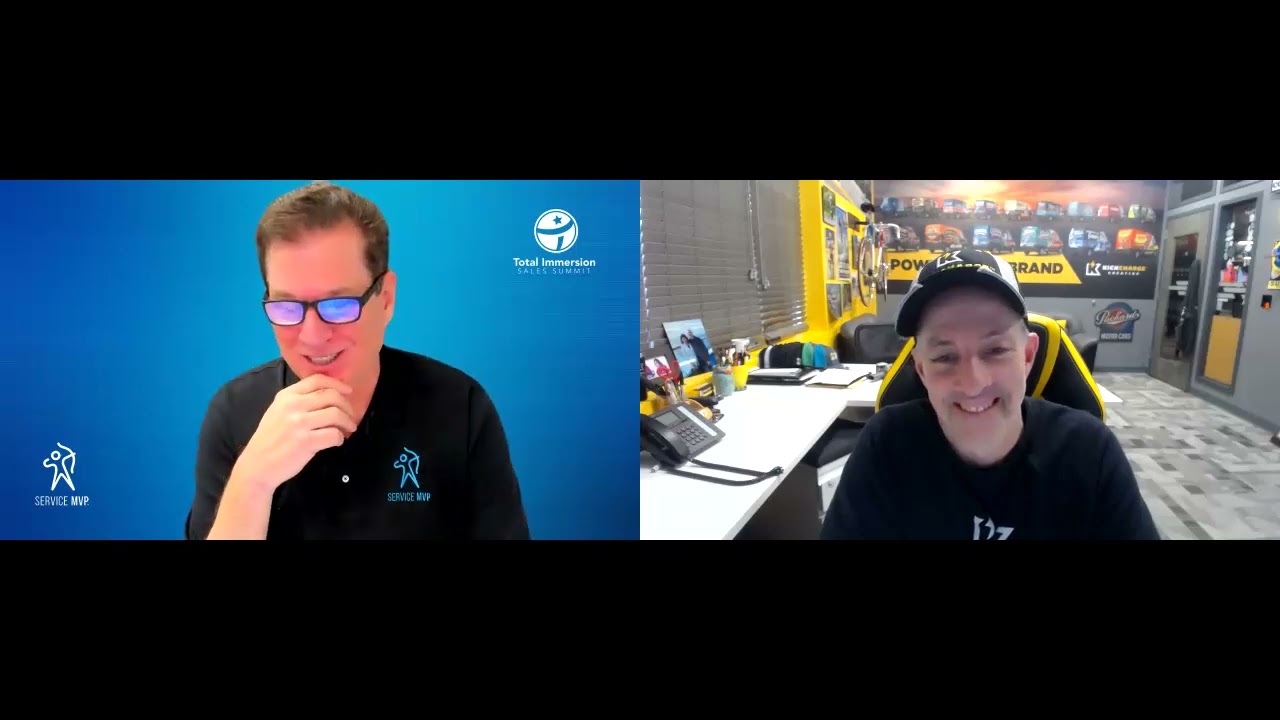
A later Ryan Chute conversation distinguishes a raw inquiry from a person who arrives with referral-like context. At 11:56, Jim and Ryan discuss how prior education can make a caller closer to an appointment than an anonymous lead. Treat that as a handoff question, not a quality guarantee: record which story, guide, referral, search page, or offer the buyer encountered, what they already understand, and which decision remains open.
At 14:28, Ryan says a customer remains transactional until given a reason to be relational, then names empathy and competence as his two-part trust formulation. That is his recording-time framework, not a psychological fact or conversion promise. Operationally, let the dispatcher acknowledge the stated problem and let the technician demonstrate competence through permission, evidence, plain options, and qualified trade judgment. Do not treat familiarity as consent to broaden scope or raise pressure.
The continuity must survive the truck roll. At 33:59, Ryan says trust has to be demonstrated in the home as well as through media. Add a short context field to the customer record, review it before arrival, and compare the promise the buyer encountered with the actual diagnosis, estimate, and follow-up. Score booked, completed, declined, and callback outcomes by context without declaring that one source caused the result.
Use activation without discounting the brand
Sales activation includes offers, promotions, and other reasons to take a near-term step. Ryan's useful caution is that an offer can damage the reputation it is supposed to monetize. A perpetual emergency discount teaches buyers to wait for the next coupon. A vague inspection can create suspicion about what happens after the truck arrives. A stronger activation names the exact service, eligibility, limits, expiration reason, ordinary next step, and any material condition a buyer needs to evaluate it.
Before launch, compare the activation with the brand memory objective. A company that promises calm guidance should not pair it with manufactured countdowns. A company known for detailed work should not hide exclusions in a footnote. The offer may be financially aggressive, but its terms should remain truthful and operationally supportable. This is where answering buyer questions before the sales call protects both response rate and the relationship after the response.
Sequence long-form education before a bounded offer
The AdWise Creative recording gives long-form content two jobs that must remain visibly separate. At 29:39, Jim and the guest discuss using the longer format for a company story and a call to action. The transferable sequence is education first, then one bounded response step. State the problem, decision factors, limits, and who the service fits before presenting an offer; never let a countdown, gift, or price claim replace material terms.
At 1:08:32, the guest distinguishes image advertising, which keeps a company known, from direct response, which asks for action. Write that primary job into the brief before production. If the piece combines both, mark the transition and keep the response layer consistent with the trust-building material above it. Current offer language, availability, eligibility, and disclosures belong on an owned page the company can update rather than being stranded in an old recording.
Close the loop with business evidence instead of a media testimonial. At 1:10:33, the conversation points to inventory and sales records as evidence a company may already possess. For a service business, define the baseline, source, qualified appointment, completed job, capacity limit, gross-margin review, cancellations, and customer issues before launch. The recording later calls education-to-appointment automatic; this article does not adopt that outcome claim or any stated radio rate, return, demographic, or platform comparison.
Make presence ready to capture earned demand
Presence is the plumbing that turns existing demand into a reachable business. It includes an accurate entity home, service pages, maps and directory records, working phone and booking paths, and content that answers the urgent query. Ryan distinguishes this from creating demand. That distinction matters because a company can improve conversion on a search page while the number of people already predisposed to choose it remains unchanged.
Audit presence from the buyer's side. Search the brand and core services in the actual coverage area. Verify hours, service boundaries, phone routing, form completion, confirmation messages, and mobile speed. Then trace the inquiry into the customer record. Diversifying home-service discovery reduces dependency on any single platform, while consistent names, services, and proof help every channel point to the same company rather than competing versions of it.
Simplify the offer and the delivery path
A valuable middle section of the interview moves from media into operations. Ryan describes curating products, prices, payment paths, warranties, and inventory so technicians and customers face a more logical journey. The durable lesson is not to remove necessary choices. It is to stop making every employee reconstruct the catalog and every customer compare an unstructured wall of possibilities. Clear categories, documented scope, and explainable tradeoffs make the brand experience easier to repeat.
Choose a service line and map the path from inquiry through completion. Remove duplicate options, identify which choices require qualified diagnosis, and write the questions that uncover fit. Give employees a bounded way to escalate exceptions. This reduces improvisation without scripting away judgment. The same simplification helps marketing: a coherent service journey provides real stories, proof, and distinctions for the brand instead of forcing copywriters to invent a personality the operation cannot sustain.
“If we did less things better, by George, we would sell more stuff and our people would feel better about us because we made their life easier.”
Ryan Chute, episode timestamp 26:58
Match the channel to market and capacity
The recording contains strong claims about radio, television, digital fraud, reach, trust, and media economics. Those claims are Ryan's recording-time views, not facts this article independently adopts. The safer planning lesson appears when he acknowledges different strategies for different companies, budgets, and markets. Channel selection begins with service geography, reachable audience, available frequency, creative fit, operational capacity, and the campaign job—not a declaration that one medium is alive or dead.
Build a channel hypothesis that can be disproved. State whom the channel should reach, what they should remember or do, how often the message can run, and what downstream evidence will signal progress. Keep source and campaign data through the booked job rather than stopping at a platform conversion. If a channel creates calls outside the service area or demand the team cannot fulfill, the media metric may look healthy while the business result is poor.
“There are different strategies for different people, um, for different companies and for different budgets.”
Ryan Chute, episode timestamp 44:05
Measure the system, not only the lead counter
Immediate leads are visible and emotionally satisfying, which is why they can absorb the whole conversation. A balanced scorecard keeps the short term without pretending it is the entire business. Track qualified inquiries, booking rate, close rate, revenue, gross margin, repeat customers, branded search, direct traffic, referral source, and capacity by service line. Use consistent definitions so a form fill, a phone call, and a completed job do not all become the same number.
Review the three jobs together. Presence should make the company findable and the response path usable. Activation should create an explainable next step with acceptable economics. Brand work should improve recognition, preference, and the quality of future demand over time. No single metric proves causation, and the speakers' outcome anecdotes are not guarantees. The management habit is to compare cohorts, listen to customers, inspect jobs, and change one material variable at a time. Add a short monthly narrative that states what moved, what did not, what else changed in the business, and which assumption the next test will examine. That record prevents a temporary spike from being promoted into a timeless rule.
From the episode
Frequently asked questions
What is the practical difference between brand building and sales activation?
In Ryan Chute's framework, brand messaging gives a future buyer a reason to remember and prefer the company, while sales activation gives a person a specific, truthful reason to act now. Both matter, but they solve different timing problems and should not be judged by the same immediate-lead metric.
Where does search or directory visibility fit?
Ryan treats visibility at the moment of need as presence: the listings, search results, directories, and other places where existing demand can become an inquiry. Presence can capture demand, but it does not replace the message that made the buyer recognize or trust the company beforehand.
Should a small contractor use radio, television, or digital advertising?
The episode does not justify one universal channel. Start with service area, capacity, audience, budget, message, and the job assigned to the campaign. Any channel claim in the recording is Ryan's view; test the chosen mix against first-party call, booking, customer, and revenue evidence.
Source trail
See the evidence behind this article
- Advertising interview with Ryan Chute
Primary video and complete public-caption source for the three-job framework, examples, and recording-time channel claims.
- Ryan Chute at Wizard of Ads
Current first-party profile used to verify Ryan Chute's name, strategist role, and home-service focus.
- Lead Generation vs. Branding
First-party Wizard of Ads transcript that corroborates Ryan's distinction between brand messaging and sales activation; numerical prescriptions remain attributed.
- Where Should You Spend Your Ad Dollars?
First-party Wizard of Ads discussion used for Ryan's message, audience, goal, capacity, and channel-context framework, not as independent performance proof.
- Additional long-form recording: Ryan Chute
Complete public-caption source for the narrow transcript-grounded enhancement attached to this canonical page. Recording-time claims and promotions are constrained by the disclosure and claim receipt.
- Additional long-form recording: Nick Nattarella (source metadata); Nic Natarella (current first-party spelling)
Complete public-caption source for the narrow transcript-grounded enhancement attached to this canonical page. Recording-time claims and promotions are constrained by the disclosure and claim receipt.
- Current first-party identity source for Nick Nattarella (source metadata); Nic Natarella (current first-party spelling)
The upload metadata spells the guest Nick Nattarella. The current first-party AdWise site identifies its creator/founder as Nic Natarella. The direct video title is preserved exactly, while durable identity text records both labels and does not invent a reconciliation beyond the same-company evidence.